

On Thursday November 21st, 2013 in Phoenix, Arizona, USA, I met Dr. Mukesh Kapila, a former United Nations Resident and Humanitarian Coordinator, and the UN Development Program Resident Representative for the Sudan, between 2003 – 2004. He came to Phoenix for his book signing event organized by the Darfur and Beyond Organization, lead by Dr. Cory Williams, a Co-Founder.

My heartfelt gratitude to Dr. Cory Williams for inviting us to this event. I could not have met this great leader if it were not for Dr. Cory Williams and Darfur and Beyond Organization. I appreciated their work and wish them all the best of luck in their struggle for justice for the people of Darfur and others.

Before heading to the book signing event, Dr. Cory Williams (Co-Founder of Darfur and Beyond), Kuol Awan (Executive Director of the Lost Boys Center for Leadership Development), Jany Deng (Program Manager for Lost Boys Center for Leadership Development) and I, had a lunch meeting with Dr. Mukesh Kapila organized by Dr. Cory in her favorite restaurant, Pita Jungle. In our meeting, Dr. Mukesh constructively advised us of what is required of each and every mankind in addressing current social problems that happened in our watch. After briefing Dr. Kapila of the vision and mission of the Lost Boys Center for Leadership Development, and current plan to move the organization to South Sudan, he gave his personal inputs.
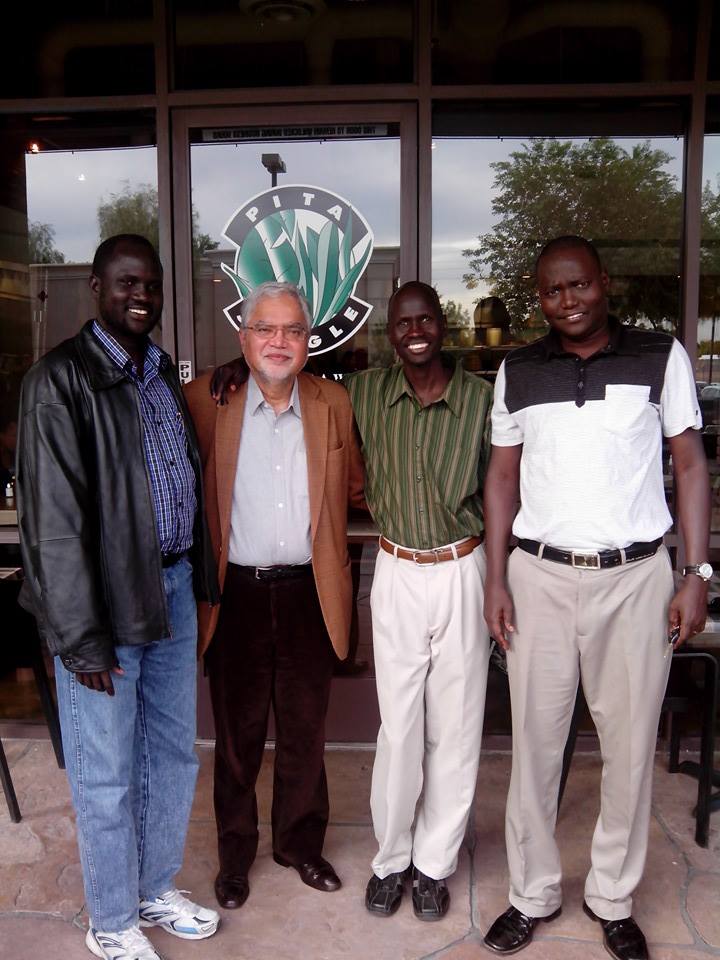
One of the ideas that Dr. Kapila suggested the Lost Boys Center for Leadership Development should do as they transit to South Sudan was to establish leadership academy for the outstanding young leaders in South Sudan. My colleagues and I were excited with his amazing ideas. He continued to advise that building South Sudan is the main responsibility of these young leaders in our communities. He justified his suggestion that developing young leaders to demonstrate moral characters and to fulfill civic responsibilities through mastery of basic skills is the key success in establishing a stable, democratic and peaceful country. This was just one of his wise ideas during our meeting with him. We noted more of such ideas. It will therefore be the responsibility of each one of us to put them to workable solution to save mankind.
I learned good lessons from meeting Dr. Mukesh Kapila. He is one of the extraordinary leaders in the world that does not concede defeat at times of crises, especially in the humanitarian disaster. He fought very hard in addressing genocidal crises in Rwanda and Darfur (Sudan). He was the one man whose voice echoed all over the world campaigning to end mass killings in Darfur and in Rwanda. Though he was receiving little response from the concerned leaders of the world, Dr. Mukesh took the bull by its horn and blew the whistle of the 21st century campaign against genocide in Rwanda and Sudan’s Darfur regions. I learned a lot from his courage and leadership ability to make thing happen comes what may. He is truly my mentor and exemplary leader of our times.

During his book signing event, Dr. Mukesh Kapila dedicated an excellent statement to me as piece of advice that I will always imitate for the rest of my life as I take my steps in the ladder of leadership. This was what he wrote: “For my Friend Hakim. Remember that real leadership comes from within – who you are and what you do”. This statement itself contains millions of action plan activities. I truly believe that leadership as defined by an author Chemers M. (1997), in the book entitled integrative theory of leadership as “a process of social influence in which one person can enlist the aid and support of others in the accomplishment of a common task”. In the definition of leadership and the my dedicated statement by Dr. Mukesh Kapila, I am informed that a person must change his inner being’s characters and work extra hard to addressing social problems facing people around him or her. By these, each one of us is deemed to be socially accepted by their communities in playing influential roles as a leader. Both the positive social inner change of an individual and what he or she does for his or her country or community have got equal weighs on determining real leadership skills of such a leader. Both authors advised us to put our focus on what we do for our people and country and who we are as individuals – in terms of characters and qualities.

If you need to read more about Dr. Mukesh Kapila, please get one of his latest books entitled “Against A Tide of Evil”. You will read more about his work in campaigning against genocide in the 21st century and his leadership ability in his previous international assignments in the challenging environments around the world. Always take your chances in meeting great leaders like Dr. Mukesh Kapila and you will learn a lot from their experiences.Thank you for reading, and we meet in the next post.
 Empowered Citizens: Engaging in Policy and Participatory Governance