
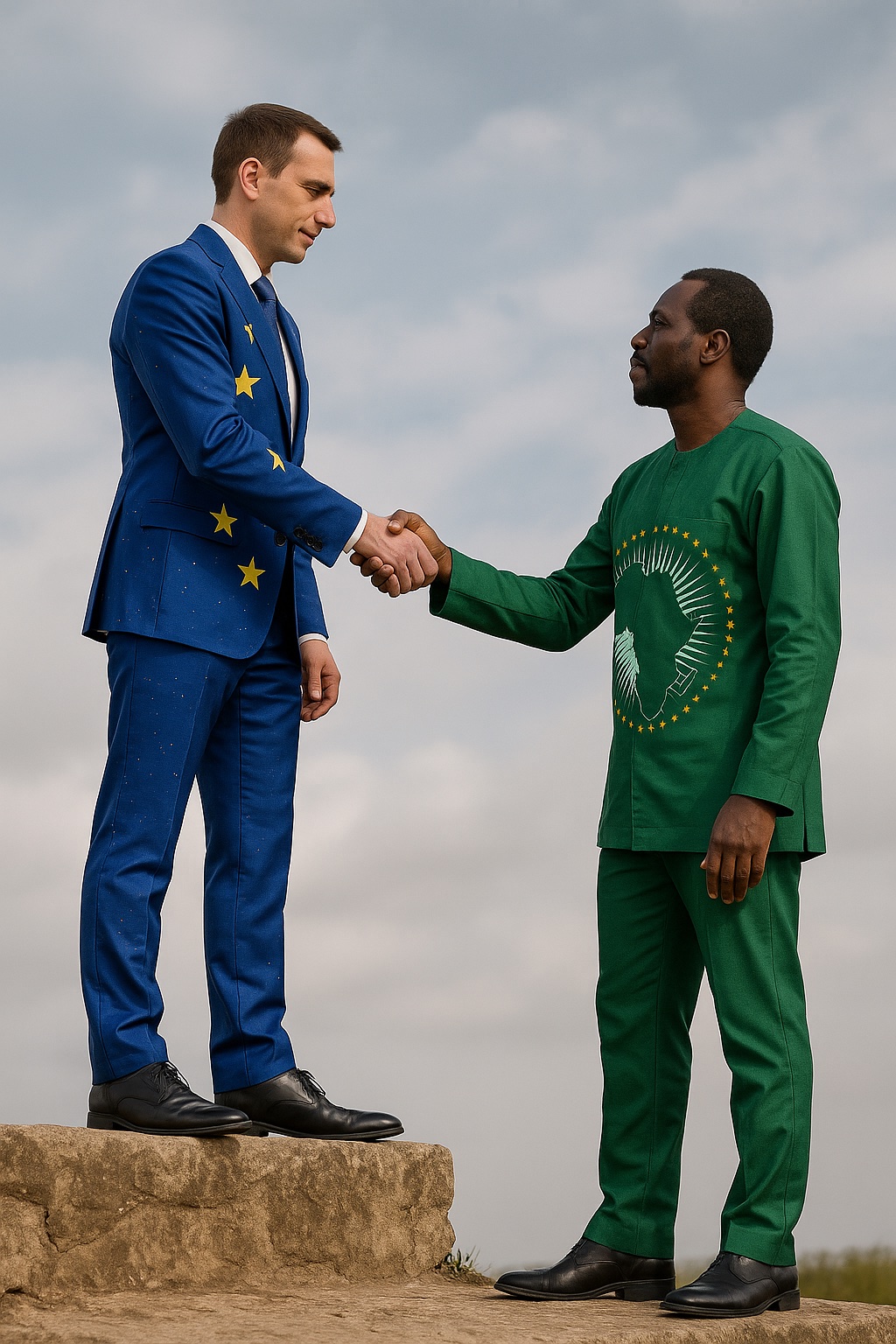
When the Joint Africa-EU Strategy (JAES) was unveiled in Lisbon in 2007, it was touted as a revolutionary partnership between two continents—Africa and Europe. The strategy sought to redefine the existing dynamic between the European Union (EU) and the African Union (AU), taking the relationship out of the donor-recipient frame into a strategic, mutual partnership. It was a call of interdependence based on values of equality, collective responsibility, solidarity, and shared development goals. But nearly two decades later, what has emerged is that the idealistic promises have not materialized for most African nations.
Essentially, the JAES was to create a partnership of equals. It was centered on common values such as democracy, good governance, human rights, and the rule of law. It planned to collaborate in trade, infrastructure, peace and security, migration, climate change, and social development. Although the paper projected a new era of cooperation, implementation has revealed that there are enduring imbalances that significantly favor European interests. This post explains how the JAES, with all its potential, has continued to reinforce historical inequalities and has failed to bring about equitable returns for African nations.
The Power Imbalance Behind the Partnership: One of the most glaringly missing aspects in the JAES is the chronic imbalance of power in the relationship. While the partnership was signed as a collective effort, the EU continues to dominate the terms of engagement. This manifests in decision-making structures, financial disbursement arrangements, and the salience of issues which show closer resemblance to European interests.
For instance, a 2021 ECDPM report documented that although they are officially represented in institutions of decision, African voices do not have as much agenda-setting power, which could still remain in the hands of European institutions. Funding mechanisms such as the European Development Fund (EDF) have EU regulations imposed on them so that they ultimately limit the autonomy of African institutions from accessing aid from their own development strategies.
Moreover, the programming cycles are strongly EU-driven with African governments responding to set EU agendas more frequently than co-designing them. This imbalance undermines the spirit of shared ownership that the JAES was intended to involve.
Economic Dependence: Trade and Resource Extraction: Another area where the disparity is obvious is economic relations, trade in this case. The EU is Africa’s biggest trading partner, accounting for approximately 33% of African exports and 31% of imports as of 2022 (European Commission, DG Trade). The trade is, however, largely in favor of Europe. Africa ships out primary raw materials, such as oil, minerals, and agricultural produce, while importing high-value-added manufactured goods from Europe.
This trend consolidates economic dependence and discourages industrial growth in Africa. The Economic Partnership Agreements (EPAs) that are intended to promote economic integration and development have come under heavy scrutiny for supporting the exports of European farm and industry while discouraging Africa from building its own base of production. The majority of African nations have seen the agreements as the continuity of colonial-style trade regimes under which the value chain benefited the developed partner, South Centre asserts.
The inability to add value to African exports not only limits employment creation but also deprives the continent of highly sought-after industrial development. Intra-African trade is low, at just about 15% of total trade compared to 70% in Europe, and highlights the structural problems that JAES has not addressed well enough.
Migration and Security: Whose Priorities? Management of migration has also become a focus area of cooperation under the JAES. Whereas the strategy purportedly seeks to address the push factors of migration—poverty, conflict, and climate change—the debate has increasingly been mobilized to provide a pretext for European border management policies.
The EU Emergency Trust Fund for Africa, established in 2015, was initially intended to tackle instability and irregular migration. However, the majority of the expenditure has been invested in border policing, security force training, and establishing return and readmission mechanisms. An Oxfam report in 2019 reported that migration cooperation has been biased towards EU security over sustainable development or human rights.
African countries, on their part, are coerced into becoming gatekeepers, limiting migration at a cost of money and aid. This compromises the agency of African states and diverts resources from long-term development programs. Instead of deploying methods to address migration through inclusive economic prospects and governance reforms, the focus is on deterrence and containment.
Limited Support for Peace and Governance: Peace and security are two of the core pillars of utmost significance to the JAES, with initiatives like the African Peace Facility (APF) supporting AU-led peace missions. While such initiatives have been successful, e.g., support to AMISOM in Somalia, they are usually short-term and reactive rather than proactive and sustainable.
Moreover, peace support operations funding is usually tardy, and African initiatives remain reliant on EU funding. This undermines Africa’s capacity to develop long-term peace infrastructures and fund conflict prevention. The AU’s African Standby Force, which should be one of the most significant peacekeeping assets, remains behind schedule in its development due, in part, to irregular financing and political support.
Good governance and human rights are also consistently evoked in JAES documents, but the aid provided in these areas is conditionally related and politically dependent. The nations supporting EU interests could be given more aid, and others are punished or cut off, which takes away from the credibility of the strategy as a genuine partnership.
Climate and Green Transition – A Missed Opportunity? Climate action and environmental protection have become increasingly areas of cooperation, particularly following the Paris Agreement. Europe’s Green Deal and its accompanying Carbon Border Adjustment Mechanism (CBAM), however, potentially put extra burdens on African exporters without offering sufficient transition support.
For example, commodity-exporting carbon-intensive African countries would face tariffs if their goods are not EU quality—but the majority have neither the infrastructure nor investments needed for sudden decarbonization. The continent has been estimated to require a minimum of $133 billion annually in climate adaptation and mitigation, but hardly any of that is being tapped.
If Africa’s unique development challenges are ignored in the EU’s green policies, they can further disconnect African economies from the international trade regime.
Rhetoric vs. Reality: Is It Still a “Joint” Strategy? Even though the JAES was hailed for its fresh vocabulary of partnership and equality, the actuality of execution is typically at odds with this rhetoric. In all but a few respects, Africa remains a junior partner to a European dominated relations’ strategy.
The 2022 EU-AU Summit reiterated the promise of an reimagined partnership, yet cynics suggest that little has changed in terms of structural shift. Until and unless the mechanisms of control, money, and agenda-setting are actually shared, the strategy is most likely to be perceived as a rebranded form of paternalism rather than as genuine partnership.
As once stated by former South African President Thabo Mbeki, “Partnerships should be between equals, not based on benevolence or charity.”
Conclusion – Reclaiming African Agency: In order for the Joint Africa-EU Strategy to fulfill its potential, it will need to undergo drastic change. African perspectives should not only be heard but also be given decision-making power. Funding mechanisms should be streamlined and tied to African development plans. Trade negotiation should focus on value addition and regional integration. Migration should be resolved through empowerment, not compulsion.
Above all, the EU must commit to relinquishing its gatekeeping role in this relationship. Africa does not need charity; it needs a fair playing field on which to develop on its own terms.
The vision of a partnership that is equal can be attained still, but will necessarily entail courage, humility, and flexibility on both sides. In the meantime, however, we must continue to ask: Was JAES ever actually a partnership, or at best a slicker extension of previous imbalance?
“Let us not merely demand fairness in rhetoric—but build it into action”. – Hakim Awuok
 Empowered Citizens: Engaging in Policy and Participatory Governance